
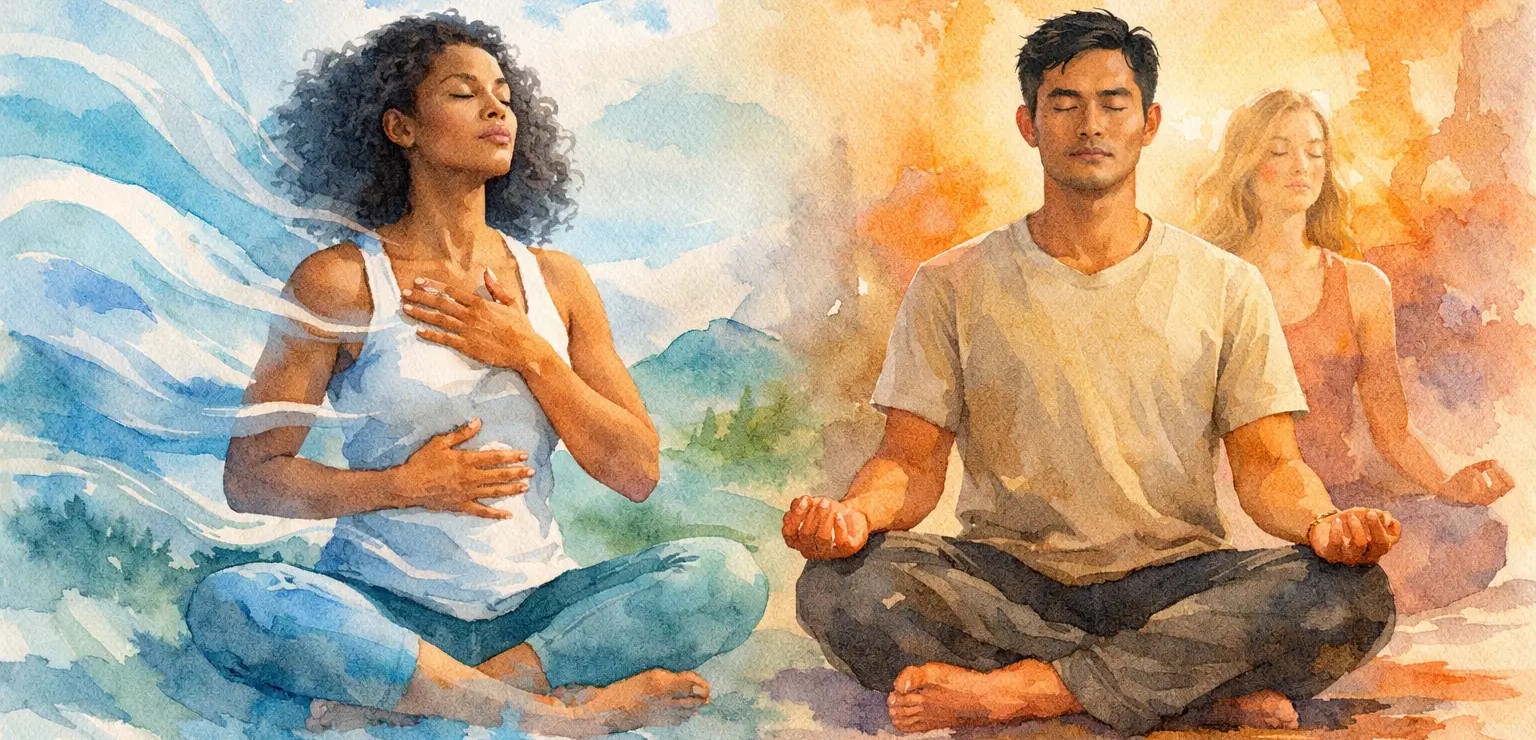
Some days, stress feels loud in the body before it ever becomes a thought. Your chest tightens, your jaw locks, your mind races, and even rest can feel out of reach. When people start looking for relief, the question often becomes breathwork vs meditation for stress – and which one will actually help when your system feels overloaded.
The kind answer is that both can help, but not always in the same way, and not always at the same moment. If you are burned out, anxious, emotionally raw, or simply exhausted from carrying too much for too long, the best practice is often the one your nervous system can safely receive.
Breathwork vs meditation for stress: what is the real difference?
Breathwork works through the body first. It uses intentional breathing patterns to shift your internal state, often quite quickly. Depending on the style, it can energize, release tension, create emotional movement, or settle the nervous system into a calmer rhythm.
Meditation usually works through awareness first. Rather than changing the breath on purpose, it asks you to notice what is happening without chasing it or pushing it away. That may include observing the breath, sensations, thoughts, or sounds. Over time, meditation can build steadiness, perspective, and a deeper sense of inner space.
This difference matters when stress is high. If your mind is spiraling but your body still feels somewhat accessible, meditation may help you slow the mental momentum. If stress feels trapped physically and you cannot think your way into calm, breathwork may be the gentler doorway.
Neither practice is better in every case. They simply meet stress from different directions.
How breathwork helps when stress lives in the body
For many people, stress is not just overthinking. It is shallow breathing, a clenched belly, fatigue mixed with restlessness, and the feeling of being stuck in high alert. Breathwork can be powerful here because breathing is one of the few body functions that is both automatic and voluntary. When you change the breath, you send signals to the nervous system that safety, regulation, or release may be possible.
Slower, longer exhalations can support downshifting. Gentle rhythmic breathing can create a sense of grounding. Some forms of breathwork also help people reconnect with sensation after feeling numb or disconnected from themselves.
That said, more intense breathwork is not right for everyone, especially if you are already overwhelmed, prone to panic, or carrying unresolved trauma. A strong breathing technique can feel cathartic for one person and dysregulating for another. This is why pacing matters. In a trauma-informed setting, the goal is not to force a breakthrough. It is to create enough safety for the body to soften.
If your stress shows up as physical agitation, tightness, or the sense that you cannot fully exhale, breathwork may offer more immediate relief than trying to sit still and think peaceful thoughts.
How meditation supports a stressed mind
Meditation is often misunderstood as the art of having no thoughts. For someone under stress, that expectation can feel frustrating from the start. In reality, meditation is not about becoming blank. It is about relating differently to what is happening inside you.
When practiced gently, meditation can help you notice stress without becoming completely fused with it. You may still hear the inner commentary, feel the pressure, or recognize the worry. The shift is that you are learning to witness it, rather than getting swept away by every wave.
This can be especially supportive for people whose stress looks like rumination, perfectionism, decision fatigue, or emotional overload. Meditation helps create a little room around those patterns. Not because they disappear instantly, but because you begin to recognize that your thoughts are not the whole truth of the moment.
Meditation can also improve resilience over time. With regular practice, many people feel less reactive, more present, and better able to return to themselves after a hard day. It tends to be subtle at first. The benefits often arrive quietly, then become unmistakable.
Still, meditation is not always easy when your nervous system is highly activated. For some people, closing the eyes and turning inward can feel too exposed. Silence may not feel soothing. It may feel like more space for stress to echo. In those moments, a body-led practice may be more supportive than a stillness-led one.
Breathwork vs meditation for stress: which works faster?
If by faster you mean, which one can create a noticeable shift in a few minutes, breathwork often has the edge. Because it directly changes breathing patterns, it can influence your state fairly quickly. A few rounds of slow breathing may help soften racing energy, reduce tension, and make you feel more anchored.
Meditation is usually less immediate, especially for beginners. Its gifts tend to build with repetition. A single session can help, but meditation often shines as a long-term relationship with yourself rather than a quick reset.
But speed is not the only measure that matters. Sometimes what feels fast is not what feels sustainable. If a breath practice is too intense, it may leave you feeling stirred up. If meditation feels inaccessible, you may abandon it before it has a chance to support you. The most effective choice is the one that helps you feel safer, more connected, and more able to stay with the practice.
When breathwork may be a better fit
Breathwork may feel more supportive if you are keyed up, restless, physically tense, or too activated to sit in stillness. It can also be a helpful entry point if meditation has always felt abstract or frustrating.
It often meets people well in moments like these: after a hard conversation, before sleep when the body will not settle, during midday overwhelm, or when burnout has left you feeling disconnected from your own breath. In those spaces, guided breathing can feel like a place to breathe again rather than another task to perform.
The best breathwork for stress is usually simple. Think soft, slow, and steady. This is especially true if your system is already carrying a lot.
When meditation may be a better fit
Meditation may be a better fit if your stress is fed by constant mental noise, future-tripping, self-criticism, or emotional reactivity. It can help when what you need is less stimulation, more witnessing, and a way to come home to yourself without trying to fix every feeling.
It can also be deeply nourishing if you already have a little capacity for stillness and want to strengthen it. Even five minutes of guided meditation, especially with a grounding anchor like the breath, sound, or body sensation, can begin to shift how you move through the rest of the day.
For many people, meditation becomes most supportive once stress is no longer at its absolute peak. It may not be the first tool you reach for in the middle of a spike, but it can become the practice that changes your baseline over time.
You do not have to choose only one
This is where the conversation becomes gentler. Breathwork and meditation are not rivals. They often work beautifully together.
A few minutes of calming breathwork can make meditation feel more accessible. Once the body softens a little, the mind may be more willing to settle. In the same way, meditation can help you notice when your breathing has become strained and invite a more compassionate response.
A simple rhythm might look like this: two to five minutes of slow, guided breathing, followed by five to ten minutes of quiet meditation or rest. That combination can offer both immediate regulation and deeper awareness.
In a supportive healing space, this kind of layered approach can be especially effective. Someone who feels too overwhelmed for stillness might begin with breathwork, bodywork, or sound healing, then gradually build capacity for meditation later. Healing does not need to be linear to be meaningful.
How to choose with care
Instead of asking which practice is best in general, ask what your system needs today. Do you need movement or stillness? Structure or spaciousness? Relief in the body or distance from looping thoughts?
Notice what happens after you practice, not just during it. The right tool may not make you feel instantly blissful. It may simply help you feel more present, less braced, and a little kinder toward yourself.
And if either practice feels hard, that does not mean you are failing. It may mean you need a gentler version, more guidance, or a different entry point altogether. Stress can make even healing practices feel like pressure. The answer is not to push harder. It is to meet yourself more softly.
There is no gold star for doing wellness the right way. There is only the slow, honest work of listening for what helps you feel safe enough to exhale, present enough to notice yourself, and supported enough to begin again.
Disclaimer: This article is for informational purposes only and does not constitute medical advice. Please consult a qualified healthcare professional regarding any medical concerns. The wellness services offered at Lucent Healing are intended to support overall well-being and complement conventional healthcare.