
What if we have far more influence over our lives, our well-being, and even our experience of reality than we’ve been taught to believe?
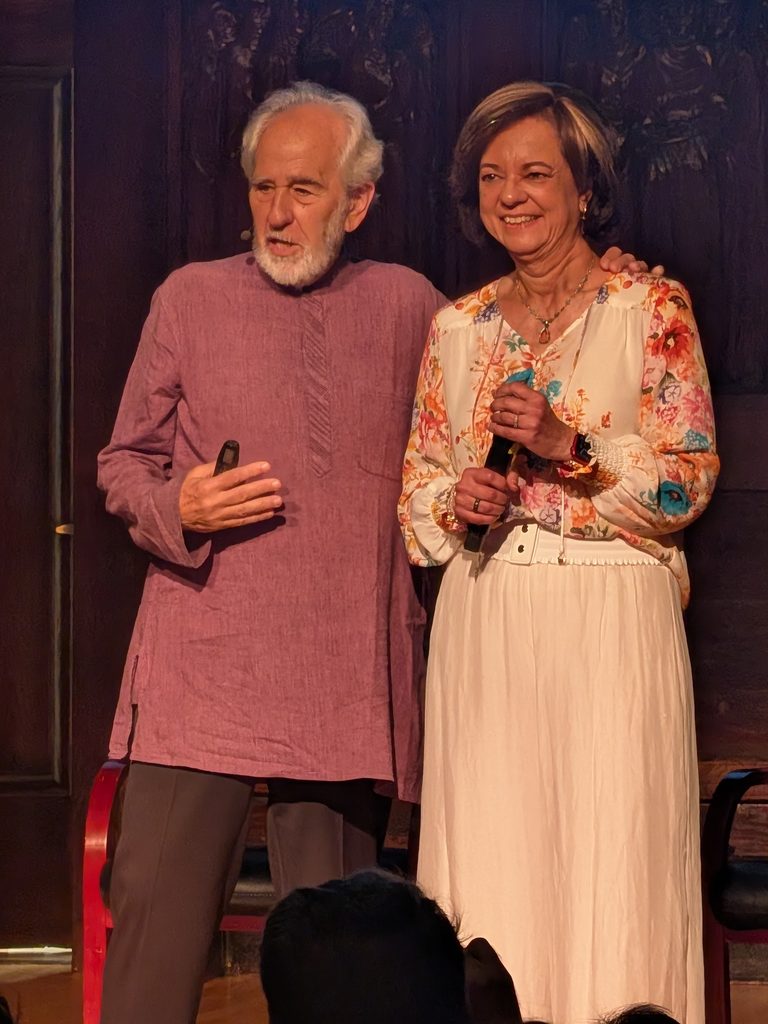
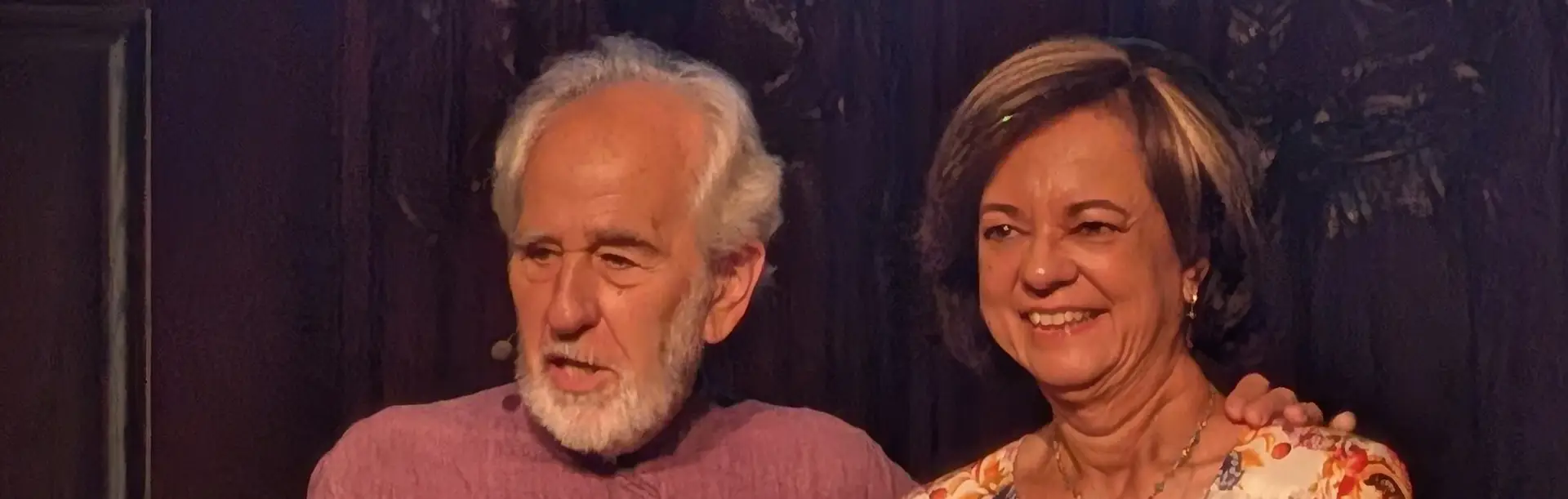
That was the central question running through Rewriting Reality: The Science of Personal Empowerment, an event in New York City featuring Dr. Bruce Lipton and Anita Moorjani. This was actually my second time seeing Bruce Lipton speak in NYC (see my post on his presentation in August 2024: Thriving Through Evolutionary Chaos), and I was excited to hear him again, this time alongside Anita Moorjani, whose remarkable story offered a very different but complementary perspective on healing, consciousness, and personal empowerment.
Although they approach the subject from very different directions- Lipton through his interpretation of cell biology, epigenetics, evolution, quantum physics, and consciousness, and Moorjani through her extraordinary near-death experience- their messages converged around a powerful idea: we are not simply passive victims of our circumstances.
Our beliefs matter. Our environment matters. Our relationships matter. The way we speak to ourselves matters. And perhaps most importantly, whether we move through life primarily from fear or from love matters.
As a hypnotherapist, sound healer, Reiki practitioner, and someone deeply interested in the intersection of science and spirituality, I found myself reflecting on many of their ideas long after the event ended.
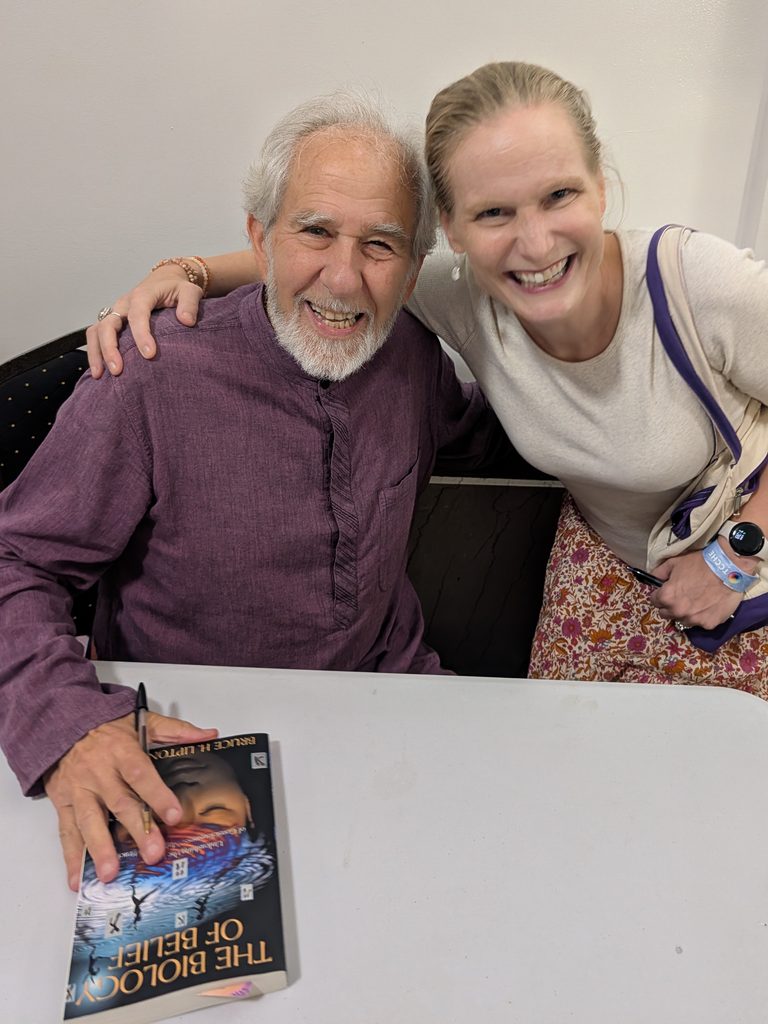
Bruce Lipton: Biology, Belief and Personal Empowerment
Bruce Lipton’s presentation wasn’t simply about biology. It was a sweeping exploration of evolution, society, medicine, consciousness, subconscious programming, physics, spirituality, and what he believes may be the next stage of human evolution.
At the center of it all was the concept of personal empowerment.
Lipton repeatedly returned to one principle:
Knowledge is power. A lack of knowledge creates a lack of power, and misperception can lead to disempowerment.
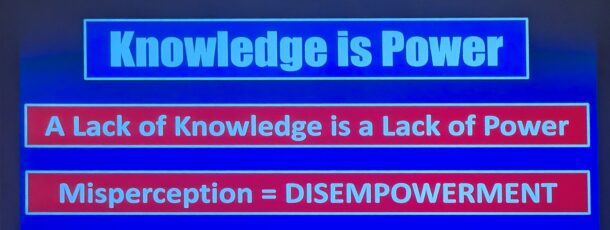
If we misunderstand how our minds and bodies work, he argued, we can begin to see ourselves as victims rather than active participants in our lives.
Are We Living in Harmony?
Lipton began on a much larger scale: the state of humanity and the planet itself.
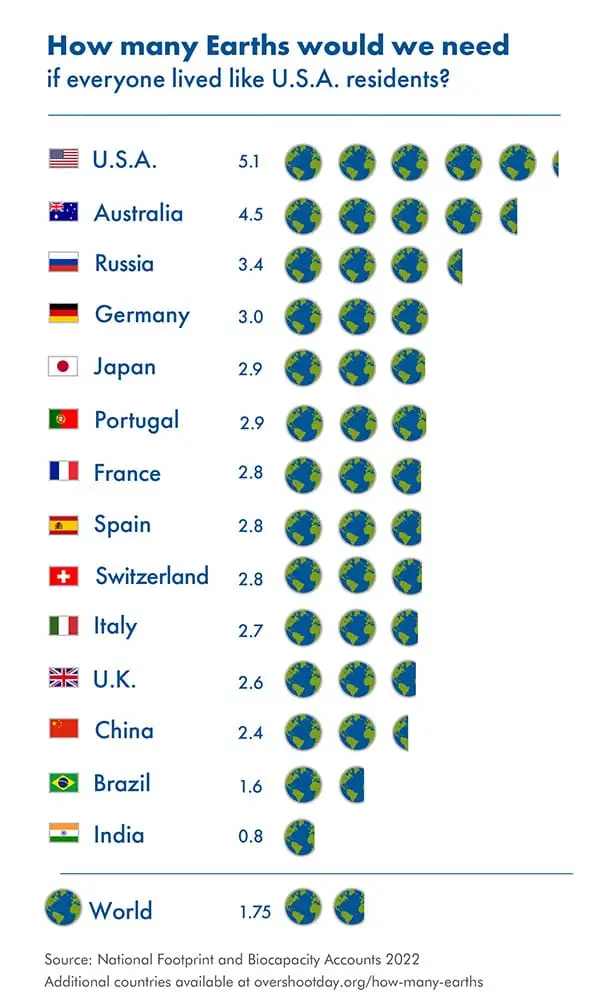
His argument was that humans have become disconnected from the natural systems of which we are a part. We consume resources faster than Earth can replenish them, alter ecosystems, experience accelerating climate change, and organize much of society around continual economic growth.
He questioned the idea that humans somehow exist separately from nature.
We aren’t separate from nature. We evolved from nature. We are nature.
Lipton connected environmental instability with economic and social instability: rising costs of living, financial inequality, corporate interests, distrust of government, climate change, and the concentration of wealth and resources.
He was particularly critical of corporations, governments, and what he sees as systems that prioritize profit over human and planetary well-being. He characterized the concentration of wealth among the world’s richest people as an extension of an old “survival of the fittest” worldview.
The larger question he posed was worth considering:
What happens when a species stops living in harmony with the system that sustains it?
Lipton referenced research and modeling that has explored scenarios in which inequality and unsustainable resource use could contribute to societal collapse. His larger message wasn’t simply that civilization is doomed.
It was that crisis can ignite evolution.
From Competition to Cooperation
Lipton challenged the popular shorthand of Darwinian evolution as simply “survival of the fittest.”
He contrasted Charles Darwin’s work with that of the earlier French naturalist Jean-Baptiste Lamarck, whose 1809 evolutionary theory emphasized organisms adapting in response to their environments. Lipton presented Lamarck as an important precursor to the modern recognition that organisms and environments interact dynamically.
He also discussed Thomas Malthus and the historical idea that population growth inevitably produces competition for limited resources, potentially resulting in famine, disease, war, and population control.
From Lipton’s perspective, this struggle-based worldview has influenced far more than evolutionary biology. It has shaped economics, politics, medicine, and the way human beings relate to one another.
His alternative was cooperation.
He referenced research into cooperation and adaptive evolution, including John Cairns’ work on bacterial mutations, to argue that evolution should not be understood purely as a sequence of random changes followed by competition.
His phrase for the alternative was memorable:
“Survival of the most cooperative.”
Look closely at nature, and you don’t simply see organisms fighting one another. You see extraordinary networks of interdependence.
A garden is a community.
A forest is a community.
The human body itself is a community of trillions of cells.
Lipton believes humanity may now be undergoing another evolutionary transition: moving from individuals competing against one another toward what he described as a new organism – a more peaceful, cooperative community of humanity.
From many comes one: E pluribus unum.
Genes Are Not Simply Our Destiny
From there, Lipton moved into the biology for which he is best known.
The discovery of the structure of DNA in the 1950s fundamentally changed biology. Lipton discussed Rosalind Franklin’s crucial contributions to that discovery and the subsequent rise of what became known as molecular biology’s Central Dogma: broadly, information moving from DNA to RNA to protein.
The cultural interpretation that followed was often much simpler:
Your genes control you.
If diabetes, heart disease, cancer, depression, or another condition “runs in the family,” it’s easy to assume that our biological future has already been written.
Lipton called this genetic determinism, and he believes it encourages a victim mentality.
His counterargument centered on epigenetics: the study of changes in gene activity that occur without altering the underlying DNA sequence.
Genes contain biological instructions, but their expression is influenced by a complex regulatory system that responds to signals inside and outside the cell.
In other words, possessing a genetic variant associated with a disease is not always the same thing as inevitably developing that disease.
Lipton took this much further, repeatedly stating that genes themselves are responsible for less than 1% of disease and arguing that lifestyle and environment account for the overwhelming majority.
He also made the much stronger statement that “there is no gene for cancer,” pointing to environmental influences and research involving adopted children to argue against genetic destiny.
The Human Genome Project and the Myth of the “Gene Switch”
Lipton also discussed the Human Genome Project, completed in 2003, and the expectations that surrounded it.
Scientists once expected humans to possess dramatically more genes than were ultimately identified. For Lipton, this was further evidence that genes alone could not explain the complexity of human life.
He described DNA as essentially a blueprint for constructing proteins.
But a blueprint doesn’t turn itself on.

Lipton emphasized that genes don’t independently decide when they should become active. Gene expression depends on regulatory mechanisms and biochemical signals.
That led him back to his central question:
If the gene isn’t independently controlling itself, what is?
His answer was the environment, and, ultimately, our perception of the environment.
Is the Nucleus Really the Brain of the Cell?
Lipton used another biological analogy to challenge conventional assumptions.
We’re often taught to think of the nucleus as the “brain” or control center of the cell because it contains DNA.
But Lipton pointed out that when a cell’s nucleus is experimentally removed, the cell does not instantly die. It can continue many basic functions for a period of time, although it can no longer reproduce normally and eventually fails.
For Lipton, that suggests the nucleus functions more like the cell’s reproductive or genetic library than its brain.
Instead, he directed attention toward the cell membrane.
The membrane separates the internal environment of the cell from the external environment while allowing information to pass between the two.
Embedded within it are receptor and channel proteins. Receptors detect signals; channels and other mechanisms help produce cellular responses.
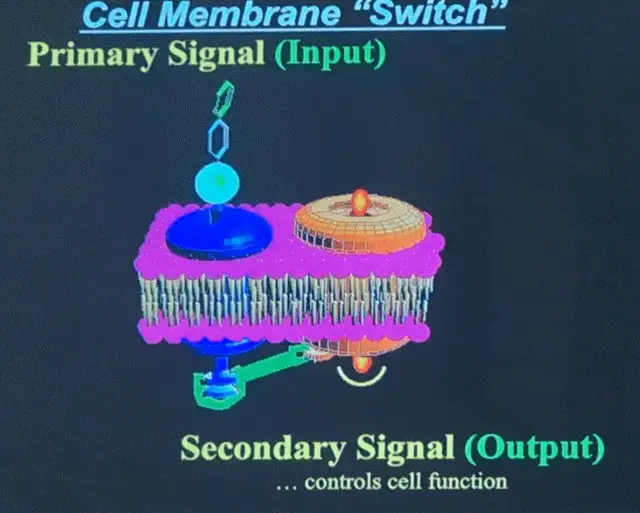
Lipton compared these structures to biological input/output switches.
Input → processing → output.
Or, in computer terminology, a biological “bit.”
The membrane’s lipid layer forms a selective barrier, while proteins embedded within it allow the cell to perceive and respond to its surroundings.
For Lipton:
Perception → awareness of the environment → biological response.
He extended this into the much more philosophical equation:
Perception = consciousness = belief.
As organisms evolved, he argued, increasing membrane complexity allowed cells to process greater amounts of environmental information. He also discussed mitochondria and the development of increasingly complex organisms, describing evolution not as a straight line but as a kind of expanding spiral.
We Are “Skin-Covered Petri Dishes”
One of Lipton’s most memorable metaphors was that human beings are essentially “skin-covered Petri dishes.”
In a laboratory, cells can behave differently depending on the culture medium surrounding them.
Stem cells, for example, have the capacity to differentiate into different types of cells depending on the signals they receive.
So what is the culture medium for the cells inside your body?
Your blood.
And the chemistry of your blood is affected by nutrition, hormones, neurotransmitters, immune signaling, stress responses, sleep, physical activity, environmental exposures, and many other factors.
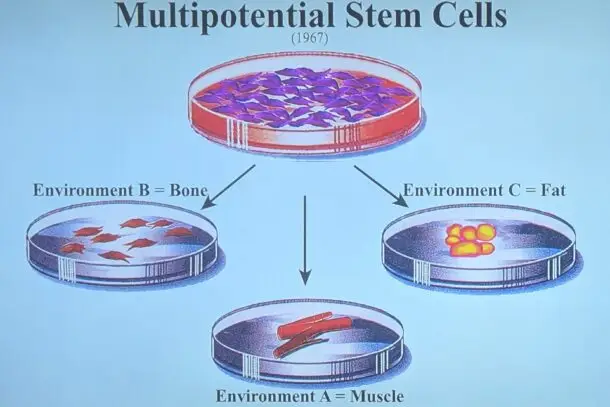
Lipton emphasized the extraordinary turnover occurring inside the body. Millions of cells die and are replaced continually. He cited estimates of tens of trillions of cells in the body and millions of cells being lost every second, while stem and progenitor cells help replenish tissues.
That means the body isn’t a static object.
You’re rebuilding yourself constantly.
Nutrition, Stress and the Chemistry of the Body
Lipton argued strongly for the importance of nutrition and questioned the nutritional quality of highly industrialized food systems.
He also challenged the idea that humans need to eat as frequently as modern culture encourages us to, discussing metabolism, free radicals, cellular stress, and longevity. He went as far as suggesting that humans should potentially be capable of lifespans approaching 150 years.
But food was only part of his point.
The brain continually changes the chemistry circulating through the body.
When we experience love, safety, pleasure, and connection, neurotransmitters and hormones associated with bonding and reward, including dopamine and oxytocin, can be involved.
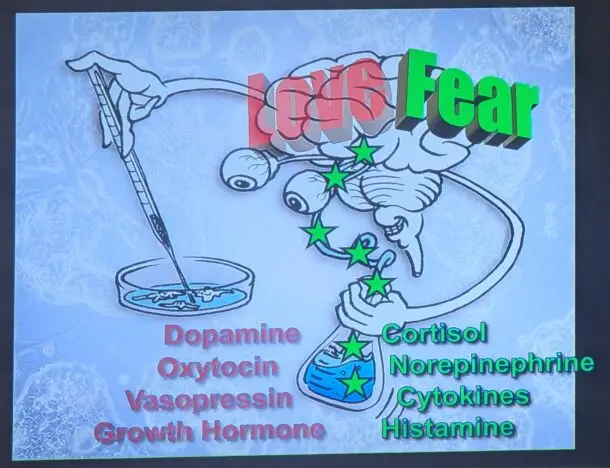
When we perceive danger, the stress response activates chemicals such as cortisol and norepinephrine.
Think about butterflies in your stomach.
Nothing necessarily happened to your stomach itself. Your perception of a situation changed, and your nervous system altered your physiology.
If a tiger appears, that’s incredibly useful.
Blood and energy can be redirected toward systems needed for immediate survival.
But what happens when the “tiger” is your inbox?
Or your finances?
Or a difficult relationship?
Or the news?
Or something you’re imagining might happen next week?
Lipton argued that chronic fear keeps us in biology designed for short-term survival.
And under acute stress, higher-order cognitive processes can become impaired.
We literally don’t think in exactly the same way when we feel threatened.
Cancer, Lifestyle and the Question of Cause
Lipton made some of his strongest claims when discussing cancer.
He argued that the overwhelming majority of cancers are related to lifestyle and environmental factors rather than inherited genetics, and he repeatedly described cancer as the body communicating:
“You’re not living in harmony.”
He argued that removing a tumor addresses the manifestation of disease but may not address all of the conditions that contributed to its development.
He also suggested that cancer treatment can remove cancer without necessarily changing the broader lifestyle or environmental conditions that might influence future disease.
But Lipton’s larger question, whether healthcare should pay greater attention to prevention, environment, nutrition, chronic stress, behavior, and whole-person well-being, is an important one.
He also pointed to research suggesting that practices such as meditation may influence biological pathways associated with stress and inflammation.
Rather than viewing mind and body as completely separate, his message was to ask how they continuously influence one another.
Medicine, Technology and Personal Empowerment
Lipton was highly critical of the pharmaceutical and medical industries.
He drew a distinction between science and technology: science generates knowledge about how nature works, while technology applies scientific discoveries to create products.
In his view, problems arise when commercial incentives begin determining how those products are developed and used.
He discussed the enormous cost of some cancer medications, giving an example of a pancreatic cancer treatment costing hundreds of thousands of dollars while extending median survival by a relatively limited amount of time.
He also discussed iatrogenic illness – harm or illness resulting from medical treatment – and cited controversial estimates ranking medical intervention among the leading causes of death.
He went further, claiming that pharmaceutical drugs kill more people than illegal drugs.
Lipton’s larger criticism concerned a healthcare model that, in his view, can focus heavily on pharmaceutical intervention while giving insufficient attention to prevention and the circumstances contributing to disease.
His answer was not simply another medication.
It was personal empowerment.
The body already manufactures extraordinarily powerful chemicals of its own. Our physiology contains sophisticated systems for repair, regulation, immunity, adaptation, and regeneration.
For Lipton, understanding those systems allows us to participate more consciously in our health rather than seeing ourselves only as passive recipients of treatment.
From Newton to Quantum Physics
Lipton then moved from biology into physics.
He described another “myth-perception”: that biology can be fully understood using a Newtonian, mechanistic worldview.
Classical physics encouraged a model of the universe as a machine composed of separate physical objects. Matter and energy seemed fundamentally distinct.
Earlier, René Descartes had famously wrestled with the relationship between mind and body.
Then physics itself changed.
The atom, once imagined as an indivisible solid object, turned out to contain smaller structures. Models evolved from classical atoms to quantum descriptions in which the behavior of matter at microscopic scales becomes far less intuitive.
Einstein’s famous equation,
E = mc²
demonstrated the relationship between mass and energy.
Lipton used this transition from classical to quantum physics to argue that the universe should be understood not merely as matter but in terms of energy and fields.
He referenced Einstein’s statements about fields and particles and extended them:
The field influences matter.
And, Lipton argues, mind and consciousness interact with that field.
This is where his presentation moved decisively beyond mainstream biological science and into a philosophical and spiritual interpretation of quantum physics.
His conclusion was:
We are each creators.
The Mind as Manifestor
Lipton described the function of the mind as creating coherence between our beliefs and the reality we experience.
Or, as the saying commonly attributed to the Buddha expresses it:
“What we think, we become.”
To explain this, Lipton divided mental activity into two broad categories: the conscious and subconscious mind.
The conscious mind is creative.
It represents our identity, wishes, desires, aspirations, imagination, and ability to intentionally choose.
This is where Lipton places positive thinking and the placebo effect.
The subconscious mind is different.
It operates more like a record-and-playback mechanism.
It contains learned habits, instincts, emotional associations, experiences, and behaviors we’ve acquired throughout life.
Lipton often describes the conscious mind as accounting for roughly 5% of our behavior and subconscious programming for approximately 95%.
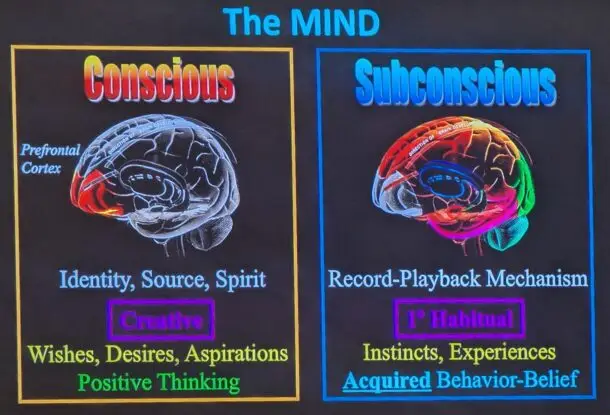
Those exact percentages should be understood as a metaphorical framework rather than a settled measurement of brain activity, but his point is immediately recognizable:
Much of what we do is automatic.
Where Did Your Programming Come From?
Think about something as simple as:
“Eat everything on your plate.”
Many people heard it repeatedly as children.
Eventually, nobody needs to say it anymore.
The external instruction has become an internal program.
Lipton suggested that a large percentage of the programming children receive is limiting or negative.
He compared the mind to a computer.
The subconscious is like the hard drive, storing programs.
The conscious mind is like the keyboard, allowing us to create.
But creativity can only take us so far if outdated programs continue running automatically underneath it.
Brainwaves and the First Seven Years
Lipton described five broad brainwave categories:
Delta: deep sleep and unconscious states
Theta: imagination, suggestibility, and states associated with hypnosis
Alpha: relaxed, calm awareness
Beta: active waking consciousness
Gamma: highly integrated cognitive processing and peak states
He placed particular emphasis on childhood.
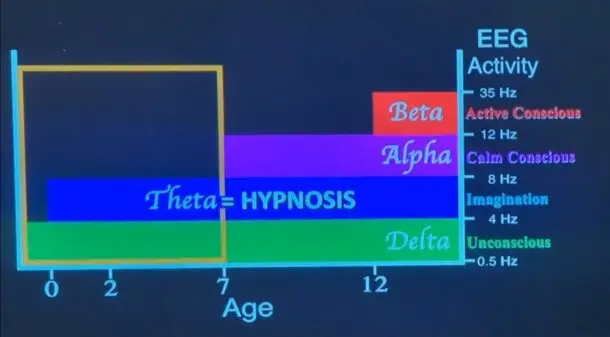
Young children spend more time in slower-wave brain states than adults, and Lipton describes approximately the first seven years as a highly programmable period.
Children need this.
Imagine having to consciously teach a child every social rule required to function within a family and culture.
Instead, children observe.
They watch their parents.
They watch siblings.
They absorb language.
They observe relationships.
They learn what gets rewarded and what gets punished.
They learn what love looks like.
They learn what money means.
They learn who has power.
And, perhaps most importantly, they begin constructing an identity.
Who am I?
The problem is that children aren’t necessarily critically evaluating everything they’re receiving.
They’re learning.
So imagine repeatedly telling a child:
You’re messy.
You’re difficult.
You’re not good at math.
You’re too sensitive.
You never do anything right.
Eventually, those statements may stop sounding like someone else’s opinion.
They can begin sounding like truth.
Lipton referenced the saying associated with Jesuit education:
“Give me a child for the first seven years, and I’ll give you the man.”
His question was:
What if some of the programming you received didn’t have your best interests in mind?
The “Truth Providers”
Lipton described several powerful sources of childhood and cultural programming as truth providers.
Parents can tell us who we are.
Teachers can tell us whether we’re intelligent.
Clergy can tell us what happens if we don’t obey religious rules.
Doctors can tell us what our bodies are capable of.
Institutions can become authorities whose statements we accept without question.
Lipton argued that this is one way people unintentionally surrender their power.
Not because parents, teachers, doctors, or spiritual leaders are inherently wrong, but because we stop asking:
Is this belief actually true for me?
Why Positive Thinking Isn’t Always Enough
This framework also explains why consciously wanting something doesn’t necessarily make it happen.
You might consciously say:
I deserve a loving relationship.
But subconsciously carry:
People always leave me.
You might consciously say:
I’m going to build a successful business.
While subconsciously believing:
I’m not good enough.
You might consciously want to rest.
While carrying a deeply embedded belief:
Rest has to be earned.
According to Lipton, when conscious intentions and subconscious programming conflict, subconscious habits frequently win because they’re operating automatically.
This is where his presentation particularly resonated with me as a hypnotherapist.
You can’t necessarily think your way out of a program that operates when you’re not consciously thinking about it.
The Honeymoon Effect
Lipton used romantic relationships to illustrate this.
Think about the beginning of a relationship.
You’re intensely present.
You’re consciously engaged.
You’re paying attention.
You’re creating something new together.
It’s the honeymoon.
But eventually everyday life returns.
Your attention moves toward work, bills, errands, children, plans, and problems.
And when the conscious mind becomes occupied, automatic programming can take over.
Suddenly, your partner may see behaviors you don’t even recognize in yourself, perhaps behaviors learned from your parents decades earlier.
Lipton’s point was that our subconscious programs become most visible when we’re not consciously paying attention to them.
Can We Rewrite the Program?
Fortunately, Lipton’s message wasn’t that we’re permanently trapped by childhood conditioning.
Programs can change.
He discussed repetition, hypnotherapy, self-hypnosis, and various approaches he groups under “energy psychology.”
He particularly emphasized the period immediately before sleep, when the brain transitions toward slower-wave states associated with greater suggestibility.
Repeatedly listening to constructive messages during this period, he suggested, can help establish new subconscious patterns.
Repetition itself is another pathway.
Practice something long enough and eventually you don’t have to consciously think about it.
Think about learning to drive.
At first, every action requires attention.
Eventually, you can arrive somewhere and barely remember consciously navigating the route.
Practice becomes program.
That means we can potentially use the same mechanism that created limiting programs to build healthier ones.
Matter + Field = Structure
From there, Lipton moved into one of the most metaphysical parts of his presentation.
He discussed magnetoencephalography (MEG), a technology capable of detecting magnetic fields associated with electrical activity in the brain without physically entering the body.
He used this as a jumping-off point for a much broader claim: that thoughts are not simply contained within the brain but exist within a larger field.
He summarized his worldview as:
Matter + Field = Structure.
And ultimately:
Spirit = Field.
Again, this interpretation extends beyond what MEG itself establishes scientifically. MEG detects magnetic fields generated by neuronal electrical activity; it does not demonstrate that thoughts exist independently outside the brain.
But Lipton used the concept to explore a fascinating philosophical question:
What if consciousness isn’t confined to the physical body?
Love, Fear and the Law of Resonance
Lipton illustrated his concept of resonance using tuning forks.
Strike one tuning fork near another tuned to the same frequency and the second can begin vibrating.
He compared this phenomenon with human beings.
In physics, waves can interact through constructive or destructive interference.

Lipton translated this metaphorically into:
Constructive interference = love.
Destructive interference = fear.
Which led to one of the central questions of his entire presentation:
Are you living in love or in fear?
What are you broadcasting into the world?
And what are you resonating with?
Lipton interprets this through his view of quantum physics and manifestation, arguing that what we broadcast helps shape the reality we experience.
Scientifically, this shouldn’t be interpreted as evidence that thoughts literally control external events through quantum mechanics.
But psychologically, the question remains powerful.
What we expect influences what we notice.
What we believe influences how we behave.
How we behave influences how other people respond to us.
And those responses can reinforce the reality we already believe to be true.
The Cell Membrane as an Information Processor
Lipton returned again to cell biology.
The cell membrane acts as the boundary between the cell and its environment.
Embedded in that membrane are receptor proteins that respond to signals and proteins involved in transmitting information into the cell.
He compared receptors to antennas.
They receive information.
Other proteins produce responses.
Lipton described these receptor-response systems as biological switches and suggested that a cell’s ability to interact with its environment increases as its membrane’s information-processing capacity expands.
For him, this is central to evolution.
Evolution becomes not simply bigger organisms but greater awareness of and responsiveness to the environment.
The Television and the Broadcast
This brought Lipton to perhaps his most spiritual analogy.
Imagine a television.
The television receives a broadcast through an antenna.
Now destroy the television.

Did you destroy the broadcast?
No.
You destroyed the receiver.
The signal still exists.
Lipton asked us to imagine the body in the same way.
He described unique “self-receptors” on cells as antennas that distinguish self from non-self. From that biological concept, he made a philosophical leap: perhaps our individual identity is like a unique broadcast received by the body.
The body is the television.
Spirit is the broadcast.
In Lipton’s worldview, when the body dies, consciousness does not.
The receiver is gone.
The broadcast remains.
His conclusion was striking:
You aren’t the television. You’re the broadcast.
And therefore, in his spiritual interpretation:
You cannot truly die because your essential identity isn’t located inside your physical body.
This isn’t something biology has established, of course. It is Lipton’s spiritual interpretation of biology, physics, and consciousness.
But it created an extraordinary transition into Anita Moorjani’s story.
Beyond Religious Labels
Lipton finished by questioning religious labels themselves.
Just as our beliefs about money, relationships, health, and identity can be inherited programs, he suggested our religious identities can be programs too.
Different cultures give the divine different names.
Different traditions create different rules.
Different communities tell different stories.
But what if, beneath those labels, we’re describing the same source?
Lipton’s spiritual conclusion was that we all come from the same source and each of us represents an expression of something greater than ourselves.
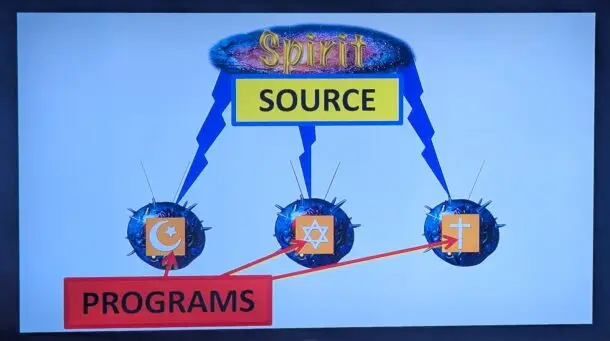
Instead of allowing labels to divide us, perhaps recognizing that shared origin could bring us back toward cooperation.
Toward community.
Toward love rather than fear.
And toward the evolutionary transition he believes humanity urgently needs.
Crisis Ignites Evolution
When I look back at the enormous territory Bruce Lipton covered – from environmental collapse and inequality to cellular membranes, DNA, epigenetics, subconscious programming, stress, quantum physics, consciousness, community, and spirit – one phrase seems to connect all of it:
Crisis ignites evolution.
A cell responds to its environment.
An organism adapts.
A person can become conscious of an old program and change it.
A community can choose cooperation instead of competition.
And perhaps humanity can recognize that the way we’ve been living isn’t sustainable and choose something different.
Lipton’s presentation wasn’t ultimately a message of doom.
It was a message of personal and collective responsibility.
We don’t have to wait for governments, corporations, institutions, doctors, religious authorities, or anyone else to give us permission to become more conscious participants in our own lives.
We can learn.
We can question.
We can become aware of our programming.
We can take better care of our bodies.
We can change our environments.
We can strengthen our communities.
We can examine whether we’re making choices from love or fear.
And we can recognize that none of us exists independently of everyone and everything around us.
Perhaps that’s what personal empowerment ultimately means – not believing that we can control everything that happens to us, but realizing that we have far more capacity to participate in our lives than we’ve been led to believe.
And from there, the presentation moved from Lipton’s theories about consciousness surviving the body to someone who believes she experienced exactly that firsthand:
Anita Moorjani.
Anita Moorjani: What Happens When Fear Disappears?
In February 2006, Anita Moorjani was gravely ill with lymphoma and experienced a profound near-death experience (NDE) while in a coma.
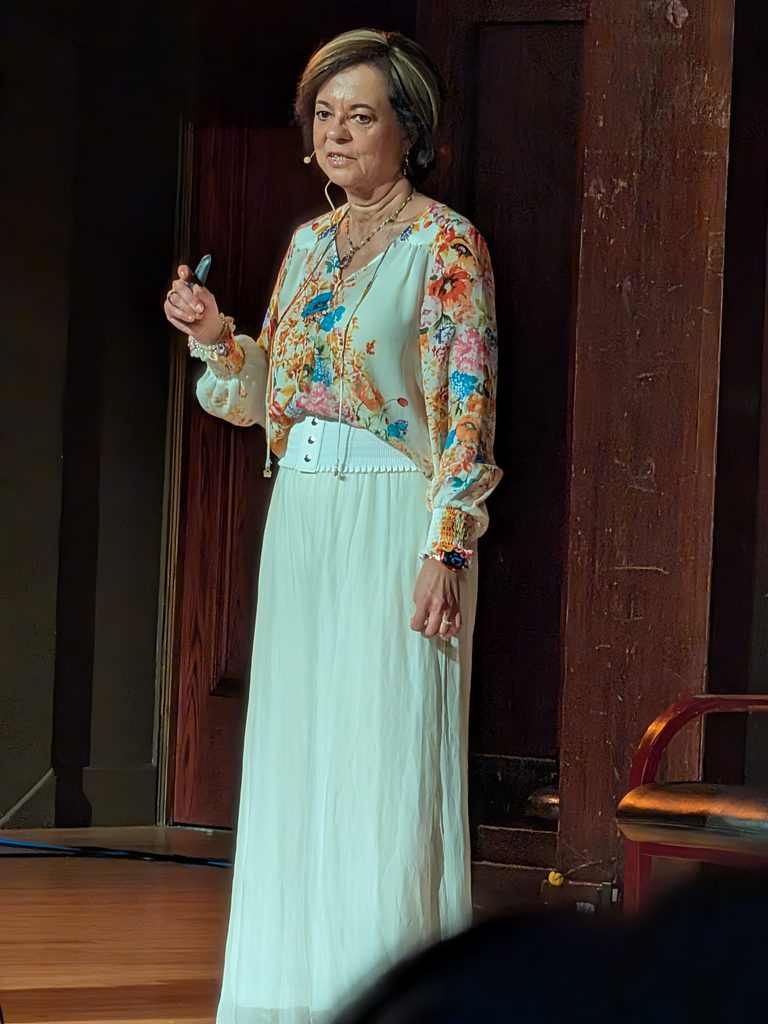
She describes entering a state of expanded awareness and overwhelming unconditional love. During the experience, she felt connected with her deceased father and believed she was given a choice about whether to return to her body.
Her father had been a significant source of fear during her life. She had grown up within cultural expectations that left her deeply afraid of disappointing her family and community, even becoming a runaway bride to escape an arranged marriage.
Yet during her NDE, she experienced her father differently.
The message she received was simple:
Go back and live fearlessly.
She chose to return.
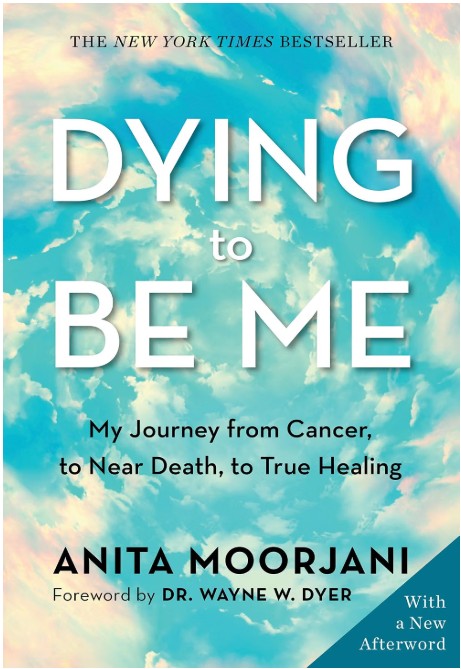
What followed was medically remarkable. Moorjani has described her tumors rapidly shrinking after she regained consciousness and ultimately disappearing. Her recovery became the foundation of her bestselling memoir, Dying to Be Me.
But the most interesting part of her story isn’t simply that she survived.
It’s what she says she learned from nearly dying.
Understanding Healing
Moorjani described her near-death experience not as a destination, but almost as a doorway – once opened, it could never completely close again.
When she returned, she felt euphoric and profoundly changed. Yet she also encountered skepticism and people attempting to explain or dismiss what she had experienced.
Before her NDE, Moorjani had spent much of her life looking outside herself for guidance and approval. Now she felt she had to do something that had once terrified her:
Trust herself.
She believed that the state of her consciousness was deeply connected with the state of her body, and that she needed to listen to her own inner voice.
This was particularly significant because one of her greatest lifelong fears had been disapproval from her community.
“What Is Your Prison?”
Moorjani described the mind as something that can become an incredibly powerful prison.
Her prison had been fear.
Fear of disappointing people.
Fear of illness.
Fear of cancer.
Fear of death.
Fear that she needed someone outside herself to save her.
Before her NDE, she saw cancer as a death sentence and believed she needed the person in the white coat to fix what was wrong with her.
Her experience prompted a question that stayed with me:
What is your prison?
Maybe it’s the belief that you aren’t worthy.
Maybe it’s believing you’re too old to change careers.
Maybe it’s believing you always have to put everyone else’s needs ahead of your own.
Maybe it’s believing your past determines your future.
Maybe it’s fear of what other people will think.
The walls of these prisons can feel incredibly real.
But sometimes they’re made from beliefs we’ve carried for so long that we’ve forgotten they are beliefs at all.
Choosing Love Over Fear
After her NDE, Moorjani said she could no longer look at religion or medicine in quite the same way.
She felt that both could become rooted in fear – religion through fear of what happens after death, and medicine through fear of disease.
Her experience led her toward a very different foundation:
Love.
Her greatest lesson was the importance of self-love.
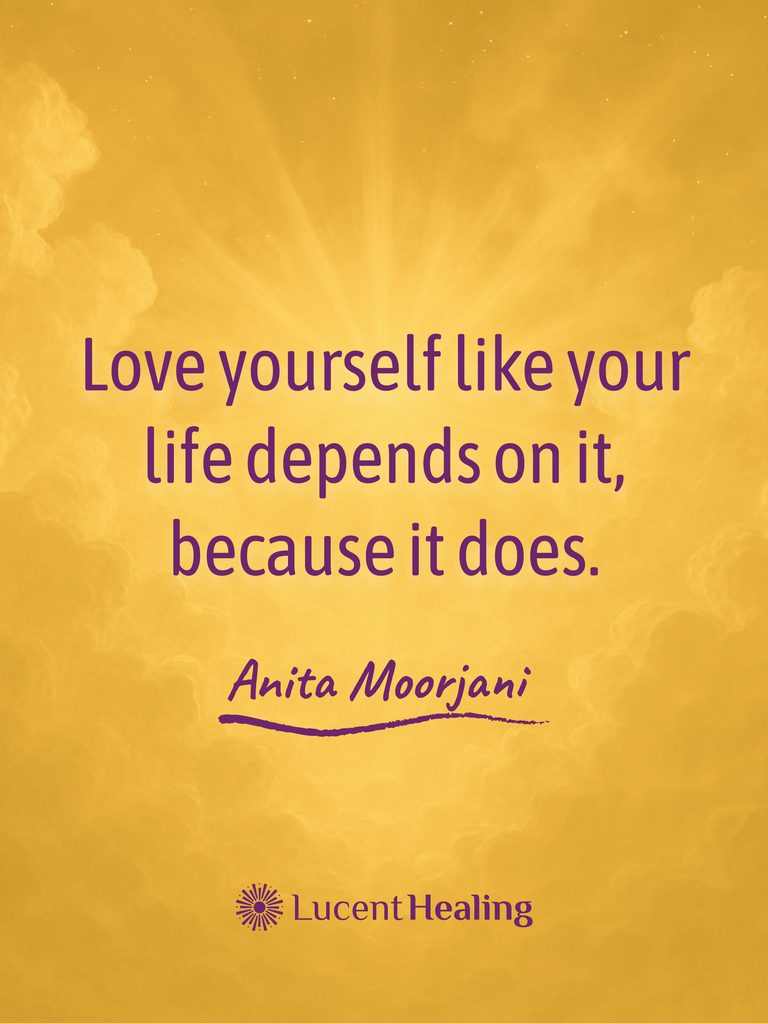
When we genuinely love ourselves, she suggested, we begin seeing ourselves as more than physical bodies trying to survive. We reconnect with something deeper and more expansive.
Moorjani believes fear, stress, and anxiety had occupied so much of her consciousness that there had been little room left for love.
Her message isn’t that someone who develops cancer caused it by being afraid, nor should her extraordinary recovery be interpreted as evidence that conventional cancer treatment is unnecessary.
Her story is her story.
But the question it raises is universal:
How would your life change if fear were no longer making so many of your decisions?
Wellness Awareness Instead of Cancer Awareness
One of Moorjani’s messages was to focus more on wellness awareness rather than constantly directing attention toward disease.
When something is wrong, our attention naturally goes toward the problem.
How do I get rid of this?
How do I stop this?
How do I fight this?
Moorjani invited us to ask something different:
What would I like to experience instead?
What does wellness look like?
How does it feel?
What are you doing?
How are you moving?
How do you feel when you wake up?
Rather than continuously visualizing the thing we’re afraid of, we can also create a mental picture of where we want to go.
That doesn’t replace appropriate healthcare.
But it changes the direction of our attention.
The Dark Warehouse
Moorjani used a beautiful analogy to explain this.
Imagine you’re standing inside an enormous warehouse in complete darkness with only a tiny flashlight.
You shine it in one direction.
Whatever appears within that small circle of light seems to be your entire reality.
But it isn’t.
There’s an enormous warehouse surrounding you filled with things you simply can’t see because your attention is somewhere else.

Now imagine turning on the lights.
Suddenly, an entire world becomes visible.
Moorjani compared this to how we experience life.
There is suffering in the world.
But there is also extraordinary kindness.
There is violence.
And generosity.
Fear.
And love.
Loss.
And beauty.
All of these things can exist simultaneously.
Yet our attention determines which part of the warehouse we’re illuminating.
The media can easily train us to believe that the darkest corner is the entire warehouse.
Moorjani reminded us that there is far more kindness and goodness in the world than we may notice when our attention is continually directed elsewhere.
You see what you focus on.
And we always have some capacity to move the flashlight.
We Are Threads in the Same Tapestry
Another of Moorjani’s metaphors was the tapestry.
Imagine being a single thread inside an enormous tapestry.
From the thread’s perspective, you can’t see the picture.
You only know what’s immediately around you.
An experience might seem pointless.
A relationship might seem random.
A painful period might seem completely disconnected from everything that follows.
But stand far enough back and the individual threads begin forming an image.
Moorjani suggested that perhaps some experiences only make sense when viewed as part of a much larger picture.
Something you went through may change you.
That change may affect someone else.
That person may affect another person.
And suddenly one thread has influenced an entire section of the tapestry.
The Disco Ball
She offered another image for interconnectedness:
A disco ball.

Imagine every mirrored tile on the ball as an individual soul.
Each looks separate.
Each reflects light differently.
Each occupies its own position.
But they’re all part of the same sphere.
When the ball moves, every tile moves with it.
Moorjani described each person as a unique facet of the divine expressing itself through a physical body.
From that perspective, hurting another person begins to look very different.
If we’re all part of the same whole, harming another is ultimately harming ourselves.
Scarcity, Competition and “Enough”
This connected remarkably well with Lipton’s earlier discussion of cooperation.
Moorjani suggested that competition often comes from fear.
Specifically:
Fear of scarcity.
There isn’t enough.
Not enough money.
Not enough success.
Not enough opportunity.
Not enough love.
So someone else’s success appears to threaten our own.
She even described billionaire thinking and scarcity thinking as two expressions of the same fundamental preoccupation with “enough.”
Her alternative was to begin questioning the assumption itself.
What if there is enough to go around?
What changes when someone else’s success doesn’t mean less for you?
What happens when collaboration replaces competition?
Again, the overlap with Lipton was striking.
Two completely different presentations had arrived at the same place:
Community over competition.
Are We More Than Five Senses?
Moorjani also spoke about intuition and what she describes as our multidimensional nature.
Her belief is that human beings are multisensory and multidimensional, but we’ve been conditioned to think of ourselves as five-sensory, three-dimensional beings.
Children often appear naturally receptive to experiences adults dismiss as imagination.
Animals seem to perceive things we can’t.
And many people have experienced moments of intuition, synchronicity, knowing, or connection that are difficult to explain rationally.
Moorjani suggested imagining that we had been born with additional senses but repeatedly told they didn’t exist.
Eventually, we would stop trusting them.
Perhaps, she suggested, something similar happens with intuition.
Her invitation was not necessarily to believe every unusual experience.
It was simply to stop dismissing our inner experience automatically.
Healing as a Mystical Experience
One of Moorjani’s most provocative statements was that healing isn’t merely a physical experience.
She sees it as a mystical experience that can result in physical transformation.
From her perspective, one of our mistakes is chasing healing exclusively through the physical body.
Instead, she encourages us to ask deeper questions.
What did your soul come here to experience?
What makes you feel alive?
Where are you betraying yourself to gain approval?
What are you afraid would happen if you truly became yourself?
What brings you joy?
Where is your energy going?
Joy as an Investment
Moorjani offered a wonderfully practical metaphor for energy.
Think of your energy like a bank account.
Things that bring you joy make deposits.
Things that chronically drain you make withdrawals.
If you continually spend without depositing anything, eventually you’re in debt.
Maybe you spend eight hours every day in a job you hate.
Maybe you’re constantly caring for everyone else.
Maybe every spare minute goes toward obligations.
Maybe you’ve forgotten what you actually enjoy.
Moorjani’s advice was not necessarily to abandon every responsibility.
It was to become conscious of your energetic accounting.
What deposits are you making?
Find things that bring you joy.
Spend time with people who make you feel alive.
Create.
Rest.
Laugh.
Go outside.
Listen to music.
Do something simply because you love doing it.
Joy isn’t frivolous.
It feeds us.
Becoming Aware
During the Q&A, both speakers returned to awareness.
Moorjani spoke about noticing our emotional state without allowing it to become our entire identity.
If you’re feeling low, afraid, depleted, or stuck, first recognize it.
Then ask:
What can I do differently?
What small action could shift my state?
Lipton returned to subconscious programming and discussed several ways he believes people can establish new patterns, including repetition, self-hypnosis, and modalities he groups under “energy psychology.”
He particularly emphasized the transition toward sleep, when the brain moves into slower-wave states.
This is also one of the reasons hypnosis interests me so deeply.
When we’re relaxed and focused, we can begin working intentionally with beliefs and associations that aren’t always accessible through ordinary analytical thinking.
Rewriting Reality
Bruce Lipton and Anita Moorjani come from very different worlds.
Lipton attempts to connect cellular biology, epigenetics, psychology, physics, and spirituality.
Moorjani speaks from a deeply personal near-death experience that transformed everything she believed about life, death, illness, fear, and love.
Not every scientific interpretation presented at the event is accepted by mainstream science, and personal empowerment should never become a reason to blame people for illness or discourage appropriate medical treatment.
But beneath all the science, spirituality, biology, physics, metaphors, and extraordinary experiences, I heard remarkably similar messages from both speakers.
Become conscious of the life you’re creating.
Notice your programming.
Question inherited beliefs.
Pay attention to your environment.
Take care of your body.
Listen to your intuition.
Choose community over isolation.
Notice when fear is running the show.
Make room for joy.
Remember that you are connected to something larger than yourself.
And learn to trust yourself.
We spend so much of our lives searching outside ourselves for someone to tell us who we are, what we should believe, what we’re capable of, what our bodies need, and what our lives are supposed to look like.
Perhaps personal empowerment begins when we become curious about another possibility.
What if some of the answers we’ve been searching for have been within us all along?
And what might become possible when we finally learn to listen?
Disclaimer: This article is for informational purposes only and does not constitute medical advice. Please consult a qualified healthcare professional regarding any medical concerns. The wellness services offered at Lucent Healing are intended to support overall well-being and complement conventional healthcare.